
| Virtual Visit: Trabuco Shrine Trail

"Truth is One, the Sages call it by various names." This ancient
affirmation of the unity of religions is embodied in the Trabuco
Shrine Trail, along which shrines to the world's major religions
have been built. The walk takes about half an hour, and is notable
for its scenic charm and serenity.

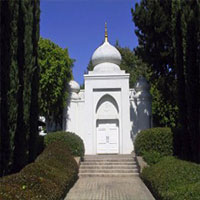
A star and crescent moon mark the shrine to Islam, which also
includes a Mihrab, or sacred niche, that orients the Muslim
worshipper towards Mecca. The symbol of star and crescent has
been associated for centuries with the religion founded by the
Prophet Muhammad.

Our Panchavati shrine recalls the largest of five sacred trees in the meditation grove (Panchavati) at the Dakshineswar Temple, India.
Within the Panchavati, Sri Ramakrishna underwent intensive
spiritual practices and later gave spiritual instructions to his
disciples.

A wooden cross stands in a spacious grove of California live oaks,
marking the shrine to Christianity. Two benches flank the clearing
where, on a rise, the cross stands.

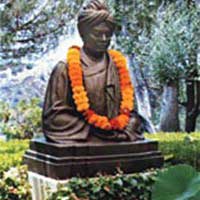
The serene face, half-closed eyes and sublime smile of the
Buddha hint at his state of enlightenment. The Buddha himself
attained enlightenment sitting under a great bodhi tree; the
Buddha on our shrine trail sits under a great oak tree.

The Star of David, mounted on a stone plinth, marks the shrine to
Judaism. Now recognized as a universal symbol of Judaism, the
symbol became commonly associated with the religion only in the
late 18th century.

The vast sky and vista opening up behind the shrine to Vedanta
suggest the infinite Brahman--the Absolute Existence-
Consciousness-Bliss which the symbol Om indicates. The Sanskrit representation of Om is seen atop a graceful wooden arch.

The Medicine Wheel, sacred to certain Native American nations, is
found on a hilltop, sheltered by a pepper tree. While the symbolism
of the Medicine Wheel varies, it is generally a place for prayer and
ritual.
|